
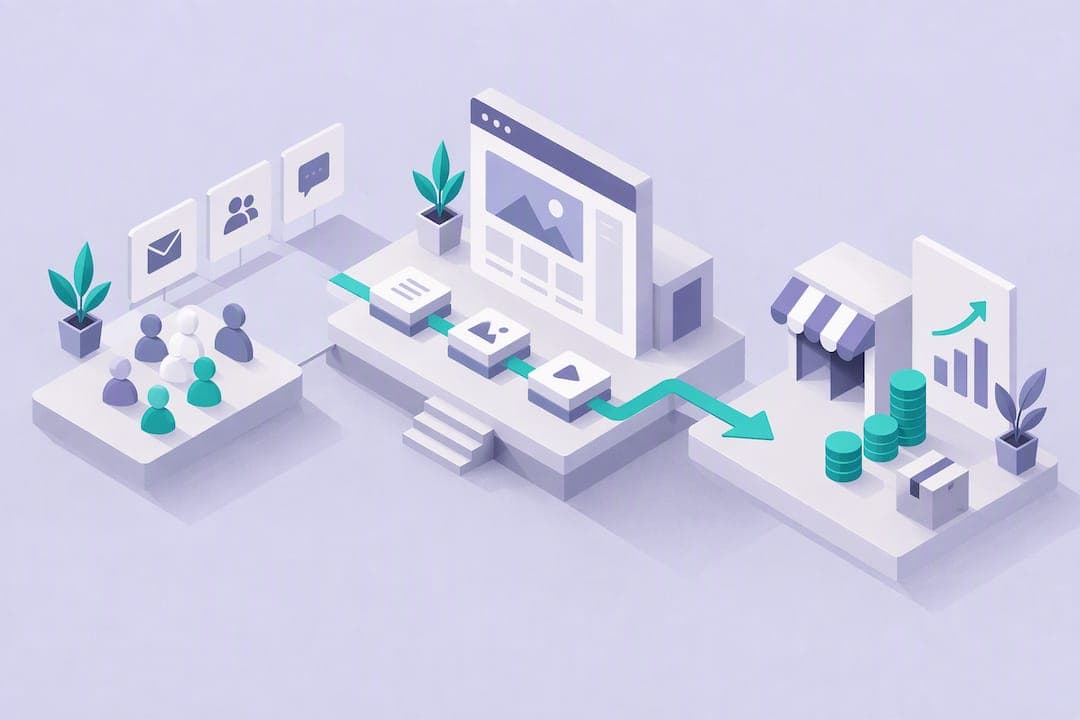
Audience monetization means converting your followers, subscribers, and site visitors into paying customers through memberships, digital products, paid events, and 1:1 bookings on your own mini-website. The two moves that matter most today are capturing email addresses from every visitor and getting a working checkout live, even a simple one, before you worry about anything else.
TL;DR:
Building a simple, effective mini-site with clear offers and instant checkout is essential before expanding into complex features or campaigns.
Owning an email list and segmenting it by engagement level significantly improves conversion rates compared to relying solely on social platforms.
Testing flexible pricing models like presales, tiered memberships, and bundling allows quick adjustments based on real data rather than guesswork.
Tracking key metrics such as conversion rate, churn, and lifetime value helps early detection of revenue issues and guides optimization efforts.
Using an all-in-one platform like Constants reduces tool management complexity and provides unified analytics to improve audience monetization.
- ✓Customizable landing page
- ✓Digital memberships
- ✓Community engagement
- ✓Performance analytics
Table of Contents
-
Core Revenue Channels: Memberships, Digital Products, Events, and Bookings
-
Turning Attention Into Purchases: Email, Launches, and Scarcity
-
What I’ve Learned Building Monetization Funnels for Creators
-
Building Your Monetization Hub Without Stitching Together Five Tools
Core Revenue Channels: Memberships, Digital Products, Events, and Bookings
Each channel fits a different stage of your business and a different kind of buyer, so most creators end up running two or three at once.
-
Memberships give you recurring revenue through gated content, community access, or ongoing coaching, and they work best once you have a steady posting rhythm to keep subscribers engaged.
-
Digital products like templates, guides, or courses are one-time sales that scale without added labor per customer, making them ideal for creators with a specific, teachable skill.
-
Paid events, whether live workshops or virtual sessions, create urgency and often price higher than digital products because they include direct access to you.
-
1:1 bookings carry the highest revenue per customer and suit coaches, consultants, and specialists whose expertise is the actual product.
On a mini-site, memberships typically run through a gated content area with automatic renewal billing, while digital products use instant download delivery after checkout. Events need a scheduling and payment flow baked into the same page visitors land on, and bookings require calendar sync so you are not manually confirming every call. The operational trick is keeping delivery and access tied directly to payment status, so nothing requires you to intervene manually once a sale happens.
What Makes a Mini-Website Convert Visitors Into Buyers
A mini-site earns its keep through a handful of parts working together, not through any single flashy feature.
Your landing page needs one clear offer, one clear call to action, and proof that you can deliver, whether that is testimonials, sample work, or a short explainer of who you help. Checkout should feel instant: multiple payment options, an automatic receipt, and a confirmation email that tells the buyer exactly what happens next. Lead capture is where many creators leave money on the table. Ask for explicit consent before adding anyone to a list, segment subscribers by what they clicked or bought, and use double opt-in so your list stays clean and your deliverability stays high.
A simple funnel looks like this:
-
Offer a free lead magnet, like a checklist or short template, in exchange for an email address.
-
Follow up with a low-cost tripwire offer, priced to remove hesitation rather than maximize profit.
-
Present your core offer, whether that is a membership, course, or booking, once trust is established.
Pro Tip: Put your lead capture form above the fold and ask for nothing but an email; every extra field cuts your conversion rate.
A unified dashboard that shows sales, active members, and traffic in one place matters because it lets you see which part of the funnel is leaking visitors before you waste money driving more traffic to a broken page.
Pricing and Packaging That Creators Can Test Fast
Pricing is a hypothesis, not a permanent decision, so build your packaging to be easy to adjust.
-
One-time pricing suits digital products and single events, where the value is delivered once and the buyer does not expect ongoing access.
-
Subscription pricing scales better for memberships and communities, since it smooths your revenue and rewards consistent content delivery.
-
Tiered memberships let you offer a low entry tier with basic access and a premium tier with 1:1 time, bonus content, or priority support.
-
Bundling a core product with a small paid extra, like a template pack or an office-hours session, raises your average order value without adding much delivery complexity.
-
Presales and early-bird pricing validate demand before you build anything, letting you refund quickly if the offer does not land rather than discovering that after months of work.
Start with a price you can defend in one sentence, then adjust based on actual conversion data rather than guesswork about what feels fair.
Turning Attention Into Purchases: Email, Launches, and Scarcity
Owning your email list is the single most reliable conversion asset you have, because it is the one channel a platform algorithm cannot throttle or take away from you.
-
Build lead magnets that solve one specific problem fast: a checklist, a swipe file, or a short micro-course works better than a long free course nobody finishes.
-
Choose a launch pattern that matches your audience size: a soft launch to a small list first, a limited cohort to create genuine scarcity, or an evergreen launch that runs continuously once your funnel is proven.
-
Use urgency and social proof carefully: a real deadline or a real cap on spots builds trust, but a fake countdown timer erodes it the moment a reader notices.
-
Pair your owned email channel with modest paid promotion once you know your numbers, rather than paying to send cold traffic into an unproven funnel.
Pro Tip: Send your launch sequence to your email list a full day before any public post; your warmest buyers should never find out about a launch from social media first.
Scarcity works when it reflects something true, like a cohort size tied to how many people you can personally support. The moment urgency feels manufactured, it stops converting and starts costing you trust with the audience you worked hardest to build.
Legal, Tax, and Delivery Checklist for Digital Sales
Selling digital goods and services comes with a few compliance steps that are easy to overlook until a refund dispute or a tax notice forces the issue.
-
Keep detailed records of every sale alongside any platform reporting you receive, since a platform report is meant to help your recordkeeping, not replace your own tax calculations.
-
For instant digital downloads, get explicit buyer opt-in for immediate delivery at checkout; this is how you waive the standard cancellation right that would otherwise apply to online sales.
-
Be transparent at checkout about price, applicable taxes, fees, and exactly how and when the buyer will receive their purchase.
-
Confirm who is responsible for VAT on your sales, since responsibility can fall on a platform operator unless specific conditions identify you as the supplier of record.
UK digital platforms are required to collect and report creator earnings to tax authorities each year, broken down by quarter, with a copy provided to the seller, according to GOV.UK reporting rules. That report is a recordkeeping aid, not your final tax filing, so an accountant familiar with digital sales is worth the conversation before your first big launch.
Metrics and Signals to Measure Success
A small set of numbers tells you almost everything about whether your monetization is working.
-
Conversion rate shows what share of visitors become paying customers, and it is the first number to watch after any landing page change.
-
Average revenue per user (ARPU) tells you whether your pricing and packaging are pulling their weight across your whole customer base.
-
Churn on memberships reveals whether your ongoing content or community value is strong enough to keep people paying month after month.
-
Lifetime value (LTV) combines ARPU and churn into the number that should actually guide how much you are willing to spend acquiring a new customer.
-
Signups per channel and email conversion rate show you where new customers actually originate, so you stop guessing which platform deserves more of your time.
-
Open rates and active member counts are leading indicators: a list that stops opening emails or a membership that stops logging in is telling you revenue trouble is coming before it shows up in your bank account.
A simple dashboard that connects visits to revenue, even a spreadsheet updated weekly, beats an elaborate analytics setup nobody actually checks.
Building and Segmenting Your Audience Before You Monetize
Monetization works best when it is built on an audience you already understand, not one you are hoping will show up. Before adding a single paid offer, spend time figuring out who actually engages with your content: what they comment on, what they click, what they ask you directly. That information becomes the basis for segmentation, which is the practice of grouping your audience by interest, intent, or buying stage so your offers reach the right people instead of everyone at once.
A simple segmentation might split your list into casual readers, engaged fans who comment or reply, and people who have already shown buying intent by clicking a pricing link or attending a free session. Each group deserves a different message: casual readers need more trust-building content, engaged fans are ready for a lead magnet, and buying-intent segments are ready for a direct offer.
Growing your audience before monetizing also means resisting the urge to sell too early. A list of a few hundred genuinely engaged subscribers who trust your judgment will outperform a much larger list that barely opens your emails. Build that trust first through consistent, useful content, then layer in your first paid offer once you can see real engagement patterns, not just follower counts, in your data.

Keeping Your Audience Engaged for the Long Term
A single sale is easy. Repeat revenue depends on whether people still care what you have to say six months later, which means engagement strategy is really retention strategy in disguise.
Consistency beats intensity here. A predictable rhythm, whether that is a weekly newsletter or a monthly live session, trains your audience to expect and look forward to your content, which keeps your list warm between launches. Community features, like a members-only discussion space or regular office hours, give paying customers a reason to stick around even between big content drops.
Personal touches scale further than most creators expect. A short personal video update, a direct reply to a comment, or a shoutout to an active member costs you a few minutes but builds the kind of loyalty that turns a one-time buyer into someone who renews a membership automatically or books you again without being asked. Pair that with simple feedback loops, like a quick survey after a launch, so your offers keep evolving with what your audience actually wants rather than what you assumed they wanted a year ago.
What Successful Audience Monetization Actually Looks Like
The creators who monetize most reliably tend to share one habit: they build around owning the relationship, meaning their own email list and their own site, rather than renting an audience entirely from a social platform. A coach who moves email subscribers into a tiered membership with a low-cost community tier and a premium 1:1 tier captures both volume and high-value customers from the same audience. A template seller who bundles a core digital product with a small paid add-on, like a personalized review session, lifts average order value without building a second product from scratch.
The common thread across these examples is sequencing: free content builds trust, a lead magnet captures contact information, a lower-priced offer proves value, and a core offer closes the sale. None of it depends on a huge following. A tightly segmented list of genuinely interested subscribers consistently outperforms a larger, unsegmented one, because conversion depends far more on trust and relevance than on raw reach.

Common Pitfalls That Stall Audience Monetization
Most monetization efforts that stall share a few recognizable mistakes. Relying entirely on a social platform’s built-in audience, with no email list of your own, means an algorithm change or account issue can cut off your income overnight. Pricing based on guesswork rather than a quick presale or early-bird test often leads to launching at the wrong number and then struggling to raise or lower it credibly later.
Overcomplicating the first offer is another common trap: a creator tries to launch a membership, a course, and a booking service simultaneously, splitting attention across three unproven funnels instead of validating one. A checkout that asks for too much information, or that fails to send a clear confirmation, quietly costs sales that never get traced back to the real cause.
The fix for most of these is the same: start with one channel, one clear offer, and one simple funnel, and only add complexity once the first piece is reliably converting. Track your core metrics from day one so a problem shows up in your dashboard before it shows up as a slow month in your bank account, and keep your audience relationship, through email and your own site, as the asset you build hardest to protect.
What I’ve Learned Building Monetization Funnels for Creators
The creators who struggle most with audience monetization usually have an audience problem, but not the one they think. They have followers, sometimes plenty of them, but no owned relationship with those people: no email list, no direct line of contact, nothing that survives a platform policy change.
The ones who succeed treat their mini-site as the hub and social platforms as the funnel feeding it. A dashboard that shows sales, active members, and traffic together, rather than three disconnected tools, shortens the path from a cold lead to a repeat buyer because you can actually see where someone drops off instead of guessing. On platforms like Constants, that kind of visibility seems to be what separates a hobby from a sustainable income.
Building Your Monetization Hub Without Stitching Together Five Tools
Most of what this guide covers, a landing page, checkout, memberships, bookings, and analytics, usually means piecing together separate tools and hoping they talk to each other. We built Constants so you would not have to: one mini-site that handles your landing page, digital product delivery, memberships, paid events, and 1:1 bookings, with AI-assisted personalization and analytics built into the same dashboard.

That means the funnel we just walked through, lead magnet to tripwire to core offer, runs through a single system instead of a patchwork of plugins and spreadsheets. Our Premium plan is $29.99 per month and includes the mini-site, membership, and booking tools this guide describes; Essentials is also available, with pricing on request. If you are ready to stop managing five tools and start managing one business, check out our pricing page to see which plan fits where you are right now.
FAQ
What is the fastest way to start monetizing an audience?
Capture email addresses from every visitor and add a working checkout, even a basic one, before building anything more elaborate. A single digital product or a low-cost tripwire offer is usually the quickest first sale a new mini-site can generate.
Do I need a large following before I can monetize?
No, a smaller, genuinely engaged list often converts better than a large, passive following because trust drives purchases more than reach does. Segmenting your existing audience by engagement level typically matters more than growing it further before your first launch.
What should I include on a digital product receipt?
Your receipt should confirm the price paid, any taxes or fees, and exactly how and when the buyer will receive the product. Getting explicit buyer opt-in for immediate delivery at checkout is also standard practice for waiving the usual cancellation window on digital downloads.
How much does Constants cost?
The Premium plan on Constants costs $29.99 per month and includes mini-site, membership, and booking features. The Essentials plan is also available, with its price listed on request on the same pricing page.
Which metrics actually predict long-term revenue?
Conversion rate, average revenue per user, churn, and lifetime value together give the clearest picture of whether your monetization is working. Engagement signals like email open rates and active membership logins tend to predict revenue trouble or growth before it shows up in your bank account.