
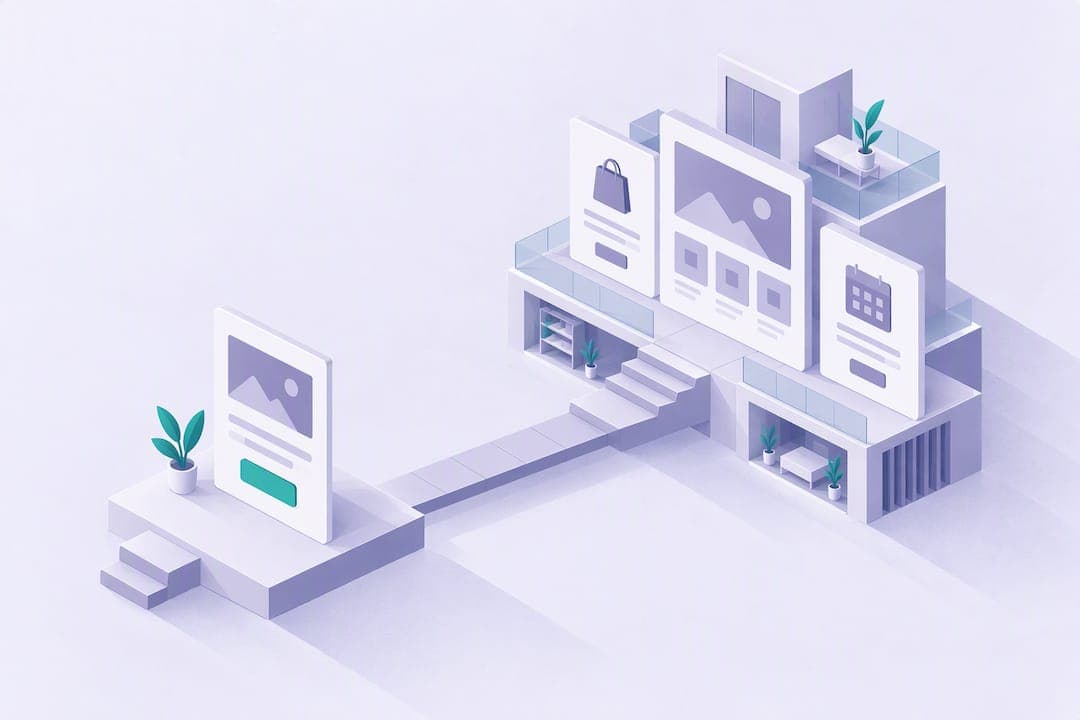
Most creators and small sellers need both: a website as the long-term home for your brand, plus landing pages for specific campaigns that come and go. The simple rule is this: a landing page serves one audience and one action, while a website needs to serve every kind of visitor who shows up. Below, we break down the differences, a decision tree for your next move, and a build checklist you can use today.
TL;DR:
- Use a landing page for paid ads, email promotions, launches, or tests with controlled traffic; its single call to action keeps visitors focused.
- Build an indexed website with multiple pages when people search for your brand or need account access, bookings, schedules, or content after purchase.
- Keep campaign pages used only for ads out of search results, but leave evergreen pages indexable and rebuild proven winners as permanent service pages.
- Set one conversion goal, track conversion rate and acquisition cost, and test only one major change at a time to identify what improves results.
- A landing page can launch in days, while a full business website often takes weeks or months and costs more to build and maintain.
Table of Contents
- What is a website? Definition, purpose, and core elements
- What is a landing page? Definition, essential elements, and uses
- Side-by-side comparison: landing page vs website (quick reference)
- Three-question decision tree: how to choose right now
- How to build an effective landing page: checklist and testing tips
- SEO, indexing, and domain strategy: where landing pages should live
- Costs, timelines, and what to measure (landing page vs website)
- How Constants helps creators ship a landing page that scales into a selling portal
- FAQ
- Sources
What is a website? Definition, purpose, and core elements
A website is a multi-page, navigable hub that handles every kind of visitor intent at once: someone searching your name on Google, a past customer checking your schedule, a new lead comparing you to three other coaches. It's built to be found through search, to answer a dozen different questions, and to keep working for you long after a single campaign ends.
A few pages tend to show up on nearly every working website, and each earns its spot for a specific reason:
- Homepage: orients new visitors and signals what you do and who you serve.
- Service or product pages: let visitors compare offers and find the one that fits them.
- Blog or guides: answer common questions and build organic search traffic over time.
- Contact page: removes friction for anyone ready to reach out.
- Login or portal area: gives paying customers ongoing access after purchase.
NN/g's research on homepage design points out that visitors who land on a deep, specific page often click back to the homepage just to reorient themselves and confirm they're in the right place. That single behavior explains why a website's real strength isn't any one page: it's the whole structure working together. Search engines can crawl it, index it, and send you new visitors for years without a dollar spent on ads. A blog post you write in 2026 can still bring in traffic in 2028.
A website also carries the weight of retention. Once someone becomes a customer, they need somewhere to log in, check a schedule, or revisit your library of resources. A landing page can sell once. A website is built to sell, serve, and keep serving.
If you're weighing a simple link-in-bio page against a true storefront, it helps to see how a single page can still function as a selling hub before you commit to building a full site.
What is a landing page? Definition, essential elements, and uses
A landing page strips everything down to one audience, one traffic source, and one action. There's no navigation menu pulling attention away, no blog links competing for clicks, and no second offer muddying the message. Everything on the page points toward a single next step: buy, register, or sign up.

The best landing pages also practice message match: the headline on the page echoes the exact promise made in the ad, email, or link that brought someone there. If your Instagram caption promises "a free 5-day meal plan," your landing page headline should say exactly that, not something broader like "fitness resources."
A handful of elements show up on nearly every landing page that converts:
- Headline: states the offer and the benefit in one line.
- Concise copy: answers objections without burying the ask.
- Single call to action: one button, one goal, repeated if needed.
- Social proof: a testimonial, logo, or number that builds trust fast.
- Minimal navigation: no exit ramps away from the one goal.
- Tracking setup: a pixel or analytics tag that measures the result.
Landing pages tend to show up around paid ad campaigns, email promotions, product launches, event signups, and quick idea validation before a bigger investment. A coach testing a new cohort-based program might build one landing page, run a small ad budget behind it, and know within a week whether the idea has legs.
Pro Tip: Write your landing page headline before you write the ad. If the headline can't stand alone, the ad won't convert either.
Side-by-side comparison: landing page vs website (quick reference)
The two formats diverge sharply once you line them up attribute by attribute. Snowball's comparison of landing pages and websites frames the choice as one of scope: a landing page handles one job well, while a website is built like a building with many rooms, each serving a different visitor need.
| Attribute | Landing page | Website |
|---|---|---|
| Purpose / goal | Drive one specific action | Serve many visitor intents |
| Traffic source | Paid ads, email, social links | Organic search, direct, referral |
| Navigation / structure | Minimal or none | Full menu, multiple pages |
| Search visibility / indexing | Often noindex during campaigns | Indexed and built for discovery |
| Measure of success | Conversion rate | Traffic, retention, revenue over time |
| Lifespan | Days to weeks (campaign-based) | Years, with ongoing updates |
| Typical build time / cost | Hours to a few days | Weeks to months |
| Data produced | Single-goal conversion data | Broad behavioral and SEO data |
Each row carries a practical implication. If your traffic comes from one paid channel, a landing page's lack of navigation keeps visitors focused instead of wandering off. If your traffic comes from search, you need the structure and indexing that only a website provides. If you're measuring one goal, a landing page's single conversion metric is cleaner than trying to track one action buried inside a busy homepage.
Landing pages typically convert better for narrow, single-offer campaigns, while homepages and full websites perform better for broad information and long-term search visibility, according to HubSpot's comparison of the two formats. That split is exactly why most working creators end up running both rather than picking one and abandoning the other.
The lifespan row deserves a second look. A landing page built for a product launch often gets archived once the launch window closes, while a website keeps accumulating value: more pages, more backlinks, more reasons for search engines to trust it. If you're only ever going to build one asset, the website has the longer payoff. If you need to move fast on a single offer, the landing page wins on speed every time.
Three-question decision tree: how to choose right now
You don't need a marketing degree to make this call. Three questions, answered honestly, point you toward landing page, website, or both.
- Is this a single, time-limited campaign with controlled traffic? If you're running paid ads, an email blast, or a launch window with a clear end date, build a landing page. A fitness coach promoting a 4-week challenge doesn't need a new website section; she needs one page that converts clicks from her ad into signups.
- Do people search for your brand or offerings by name? If potential clients Google your name, your niche, or "coach near me," you need a website. Search visibility only comes from an indexed site with enough pages to rank, and a single landing page can't carry that weight on its own.
- Do customers need accounts or repeat access after purchase? If buyers log back in to view a course, check a booking, or manage a membership, you need a website with a portal, not just a one-time landing page.
Most creators answer "yes" to more than one question, which is exactly why the practical guidance on choosing between the two usually lands on a combined answer: website as your permanent home, landing pages layered on top for each campaign. Answering "yes" to question one alone means you can likely launch with just a landing page and expand later. Answering "yes" to questions two or three means a website isn't optional, it's the foundation everything else builds on.
How to build an effective landing page: checklist and testing tips
A landing page that converts isn't complicated, but it does require discipline. Skipping any one item on this list tends to show up later as a weak conversion rate.
- Message match: the headline repeats the exact promise from your ad or link.
- Single clear CTA: one button, one goal, no competing offers.
- Benefit-driven headline: states what the visitor gets, not what you do.
- Social proof: a testimonial, review count, or recognizable detail that builds trust.
- Simple form fields: ask for only what you need to follow up.
- Fast load times: every extra second of load time costs you conversions.
- Mobile-first layout: most campaign traffic arrives on a phone first.
Once the page is live, measurement matters as much as design. Set one conversion goal before launch, whether that's a purchase, a signup, or a booking. Track your cost per acquisition alongside your conversion rate so you know whether the campaign is actually profitable, not just busy. Install your analytics and ad pixel on the same domain as the landing page itself, which keeps your first-party data clean and avoids the tracking gaps that come from using a separate, disconnected tool.
Testing should stay simple. Run one major test at a time, not five at once, or you won't know which change moved the number. Common first experiments include swapping the headline, testing a different hero image, rewriting the CTA button copy, or shortening the form.
Pro Tip: Change one variable per test. A headline swap and a new image tested together tells you nothing about which one actually worked.
SEO, indexing, and domain strategy: where landing pages should live
Where you host a landing page matters more than most creators realize. Building campaign pages on your own domain, rather than a disconnected third-party tool, keeps your analytics, pixels, and first-party data aligned with the rest of your business, a point Network Solutions makes clearly when comparing the two formats. It also means any trust you've built with search engines carries over to the new page instead of starting from zero.
A few practices keep this strategy clean:
- Set noindex on paid-only campaign pages. A page built purely to catch ad traffic doesn't need to compete for organic rankings, and HubSpot notes that these pages frequently start noindex for exactly that reason.
- Let evergreen pages stay indexable. If a landing page answers a question people search for year-round, it deserves a shot at organic traffic.
- Convert winners into permanent pages. When a campaign page proves it converts, rebuild it as an indexable service page using the same headline and structure that worked in ads, rather than starting the copy over from scratch.
This approach lets a single good idea do double duty: it drives a campaign today and becomes a permanent, search-visible asset once it proves itself.
Costs, timelines, and what to measure (landing page vs website)
Timelines tell you a lot about what each format is built for. A landing page can go live in a matter of days, often built around a single offer and a single piece of copy. A business website, on the other hand, typically takes weeks to months, since it involves multiple pages, navigation, and often a content plan that keeps growing after launch.
Cost tends to follow the same pattern. A simple landing page costs little beyond your time, while a full website with custom design, a content management system, ecommerce, or a gated member portal adds real cost and complexity. The right lens isn't the invoice, it's the lifespan: a website you update for years spreads its cost far wider than a campaign page built for a two-week launch.
Metrics diverge too:
- Landing pages: judged almost entirely by conversion rate and cost per acquisition.
- Websites: judged by organic traffic growth, visitor retention, and logged-in activity over time.
For context on what a strong landing page conversion rate even looks like, benchmark research from Courimo on landing page performance frames conversion rate as the primary signal campaign marketers should track, since it's the one number that tells you whether the page is doing its one job.
How Constants helps creators ship a landing page that scales into a selling portal
We designed our platform so you don't have to choose between a quick landing page and a real website. Your page starts as a focused landing page, with a shop for digital products, calendar-based 1:1 bookings, event tickets, recurring memberships, and a community space, all live on one page you control. As your audience grows, the same page keeps its analytics and a notes workspace so you can track what's working without stitching together separate tools.

Our free Essentials plan can sell from day one, no upgrade required before you take your first payment. Premium runs $29.99 a month and unlocks more of the platform's features. On every plan, we charge a 6% fee on one-time sales like digital products, bookings, and event tickets, and 10% on memberships and subscriptions, with Stripe card processing billed separately from that fee.
If you're currently running a bare link page and want to see what a selling-ready setup looks like next to it, our comparison of storefront options walks through the tradeoffs. When you're ready to compare plans in detail, visit our pricing page and start your free Starter page today.
FAQ
Do I need a website if I have a landing page?
Most creators eventually need both: a landing page converts a specific campaign, while a website handles search visibility, retention, and the broader set of questions new visitors bring. A single landing page can work as a starting point, but it won't replace the long-term discovery and trust that a full website builds over time.
Can a landing page be a website?
A landing page can technically be your only online asset, especially early on, but it isn't built to serve every kind of visitor intent the way a website is. Snowball's guidance on the two formats treats them as different tools for different jobs, with many businesses starting on a single page and expanding into a full site as needs grow.
Are landing pages still relevant?
Yes. Landing pages remain one of the most reliable tools for paid campaigns, product launches, and quick idea validation, since HubSpot's research shows they typically convert better than a general website page for a single, specific offer. Their relevance comes from focus, not from being newer or trendier than a full site.
How do I create a landing page?
Start with one audience, one traffic source, and one action, then write a headline that matches exactly what brought the visitor there. From there, add a single call to action, light social proof, a short form, and fast mobile-friendly load times, and host the page on your own domain to keep your tracking and data in one place.
Sources
- Landing page vs website: which one does your business need?
- Homepage Design: 5 Fundamental Principles - NN/G
- Difference between landing page and website
- Landing page vs website — HubSpot