
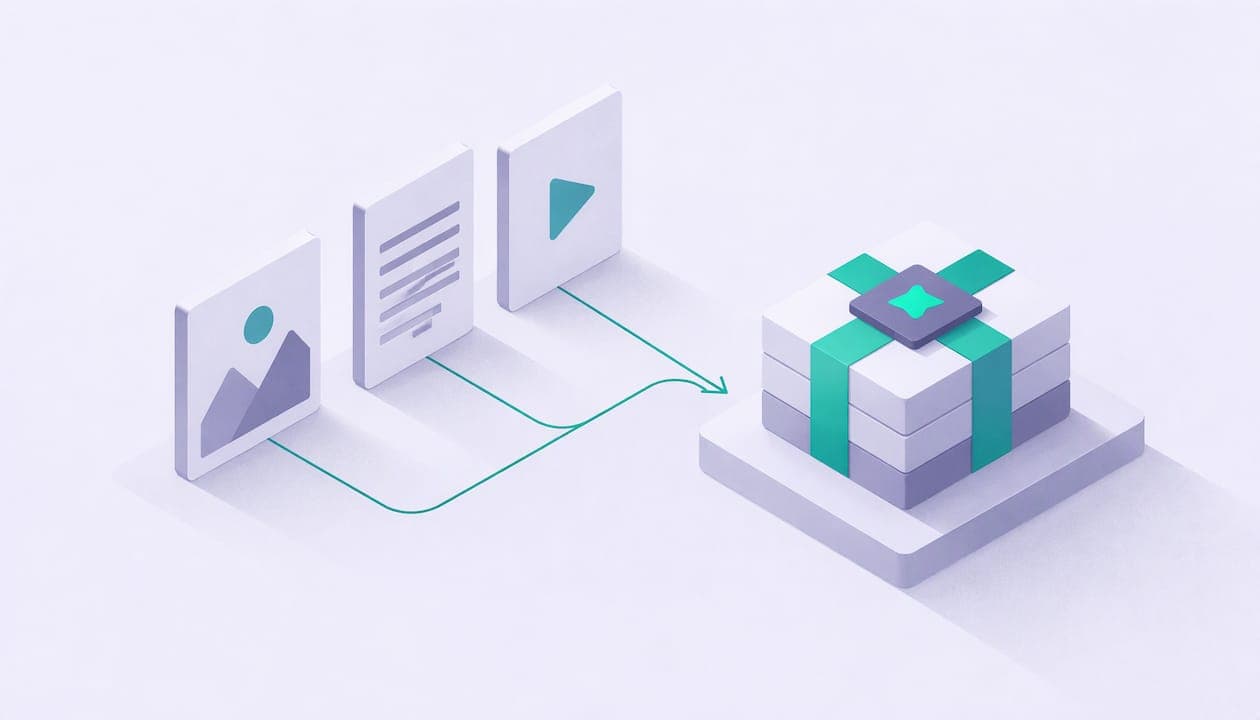
To bundle digital products, pick three to six items that solve one problem for one buyer, price the set below the total of the separate prices, and sell it as a single offer with its own name and checkout. Start with a bundle you can explain in one sentence, then adjust the price and contents using real sales data.
This guide covers what a bundle is, which products belong together, how to set the discount, how fees change your math, and how to tell whether the bundle is working. The examples are hypothetical, built to show the numbers, not to suggest results.
TL;DR
- A digital product bundle is two or more related products sold together as one offer, usually at a lower combined price than buying each separately.
- Bundle items that serve one buyer and one goal. Adding weak items can lower how valuable the whole set feels.
- Discount more when the items are nice-to-haves and less when they are things buyers already need. Run the numbers after fees before you publish a price.
- Track how many buyers take the bundle, what each customer spends, and which items drive sales, then adjust after a few months.
- Constants lets you sell products, bookings, tickets and memberships from one page, with a 6% platform fee on one-time sales and 10% on memberships.
Table of Contents
- What does it mean to bundle digital products?
- Which digital products should you bundle together?
- What makes a good bundle?
- Bundle pricing strategy: how much of a discount?
- How do fees change your bundle price?
- Product bundling strategy: tiers, bonuses and timing
- How do you sell a bundle from one page?
- How do you know if your bundle is working?
- Start your first bundle on Constants
- FAQ
- Sources
What does it mean to bundle digital products?
A bundle is a package of related products sold together, often for one combined price and often at a discount compared with buying the items one by one. Salesforce describes a product bundle as a pre-packaged or customizable set of items sold as a group. In the digital world that can mean an ebook plus a template pack, a course plus a live Q&A, or a set of presets with a tutorial.
Bundles help in two ways. For the buyer, one clear package replaces a pile of separate decisions. For you, each sale is bigger, and a customer who might have bought a single $15 item now has a reason to spend more. The same Salesforce page notes that bundling can raise perceived value, encourage larger purchases and make choices easier.
There is a catch worth knowing early. A bundle is not a clearance table. Its job is to make one outcome easy to buy, not to move every leftover file you own.
Which digital products should you bundle together?
Bundle products that belong to the same buyer and the same goal. A person who wants to launch a newsletter does not need your fitness planner, and a person who wants a meal plan probably does not need your logo templates. The tighter the match, the easier the bundle is to describe, and the easier it is to sell.
Here are three ways to build a set that holds together.
- Sequence: items that take the buyer from start to finish, such as a starter guide, a workbook and a checklist.
- Format mix: the same topic in different forms, such as a PDF guide, a spreadsheet and a short video walkthrough.
- Level mix: a beginner product, an intermediate product and an advanced product for the same skill.
Why fewer, stronger items usually win
More is not always better. Research published in the Journal of Consumer Research on the Presenter's Paradox found that people tend to average what they see, so adding mildly good items next to very good ones can pull the overall impression down. For a bundle, that means a weak bonus can make your best product look smaller.
A practical test: for each item, ask whether the buyer would be disappointed if it were missing. If the answer is no, take it out or sell it separately. A bundle of three items you are proud of beats one of eight where five are filler.
Bundle ideas for coaches, freelancers and creators
These are hypothetical examples to show how the pieces fit.
A fitness coach could package a four-week training program, a printable meal planner and a habit tracker as a "first month" bundle. A freelance designer could sell a set of social media templates, a brand style guide template and a short video on how to customize both. A writing coach could combine a guide to pitching, an email swipe file and a pack of editing checklists.
Bundles do not have to be only files. On Constants you can sell digital products, calendar-based 1:1 bookings, event tickets and memberships from the same page, so a bundle can pair a downloadable program with a booked kickoff call. If you sell ebooks, our guide on selling ebooks from your link in bio shows how a single title can anchor a bigger set. If you sell templates, testing demand before you build helps you decide what goes in the box.
What makes a good bundle?
A good bundle has a name that states the result, a short list of items with a plain description of each, and a price that makes the saving obvious. Think of it as a curated playlist: each item complements the others, and anything that adds clutter gets cut. That playlist idea comes from David Warren of the Subscribed Institute, quoted by Zuora, and it is a useful editing rule.
The market is also crowded. A Stratistics MRC report values the global digital product and course sales platform market at $2.7 billion in 2025 and projects it to reach $5.8 billion by 2032, and it points to heavy discounting and look-alike products as pressures on perceived value. The practical takeaway is to differentiate by niche and quality rather than by being the cheapest.
A few habits make a bundle stand out:
- Name the outcome, not the file count. "Launch Your First Email List" says more than "Bundle of 6 Files."
- Show the separate prices next to the bundle price so the saving is clear.
- Describe who it is for and who it is not for in one or two lines.
- Keep the delivery simple: one checkout, one place to download everything.
Bundle pricing strategy: how much of a discount?
The right discount depends on how much the buyer wants each item. Andreessen Horowitz, in its framework on when and how to bundle products, suggests that an item that is a need can be bundled with less discounting, while nice-to-have items need bigger discounts to get people to take them. It also warns that bundling products people already buy together can cannibalize revenue you would have earned anyway.
Translate that for a small seller. If your core product is the thing people come for, such as a training program, keep the discount modest and add supporting items as value. If the supporting items are optional extras, the discount has to carry more weight.
Most creator guides land on similar ranges, though they come from blogs and not controlled studies, so treat them as starting points and test. A common rule of thumb is a discount of roughly 20% to 40% off the combined separate price, with smaller sets sitting at the low end and larger sets at the high end. Begin there, then let your sales tell you whether to move.

Three common ways to price a bundle
Salesforce lists common bundle-pricing methods: a fixed price for a set group, a percentage discount for buying items together, and dynamic pricing based on what the customer selects. For a creator with a simple page, the first two are the practical ones.
- Fixed price: you pick one bundle price, such as $59, and show the total value beside it.
- Percentage off: you add up the separate prices and take a set percentage off.
- Build your own: the buyer picks items, and the discount rises with the number chosen. This takes more setup, so use it once you know which items sell.
A worked example
Here is a hypothetical fitness coach bundle.
| Item | Sold separately |
|---|---|
| 4-week training program | $49 |
| Printable meal planner | $15 |
| Habit tracker | $19 |
| Total | $83 |
Priced at $59, the bundle saves the buyer $24, which is about 29% off. That sits in the middle of the range above and reads clearly as a deal. If the coach wants the program to stay the hero, a bundle at $64 keeps the saving to about 23% and protects the main product's price.
How do fees change your bundle price?
Fees come out of every sale, so price the bundle after them, not before. On Constants, the platform fee is 6% on one-time sales, which covers digital products, bookings and event tickets, and 10% on memberships and subscriptions, on every plan. Stripe card processing is charged separately by Stripe.
Using the $59 hypothetical bundle, a 6% platform fee is $3.54, leaving $55.46 before Stripe's processing charge. Check Stripe's current rates on its own pricing page and subtract them to find your true take-home per sale. Then ask whether the discount still leaves you a margin you are happy with.

If you sell a bundle as a recurring membership, such as monthly access to a template library, the 10% membership fee applies instead. Run the same math with that rate. Our post on pricing after fees walks through the same steps for webinars, and the method carries over to bundles. If you are comparing platforms, the Gumroad fees breakdown shows how another seller's per-sale fee works out on a small order.
Product bundling strategy: tiers, bonuses and timing
Once you have one bundle, there are a few ways to shape the offer.
Tiers: offer a smaller bundle and a larger one. The larger set might add a 1:1 call or a membership month. Many buyers pick the middle option when they see three, so make sure that is the one you want to sell.
Bonuses: keep the price and add a bonus for a limited run, such as a bonus checklist for the first buyers. Use this sparingly, and only when the bonus is something you would also be happy to sell on its own.
Presale: you can sell a bundle before every part is finished, which tells you whether anyone wants it before you spend weeks building. Our guide to selling digital products with a presale explains how to set one up from a bio link.
Live element: add an event, such as a live walkthrough, as a ticketed extra. If you want to promote that kind of event beyond your own audience, a roundup of event marketing platforms gives you places to start looking.
How do you sell a bundle from one page?
A bundle sells best when the buyer sees it, understands it and checks out without leaving the page. That is where a single-page setup helps: your landing page, shop, bookings, tickets and memberships live at constants.com/yourname, so the bundle sits next to everything else you sell.
A simple setup looks like this:
- List each product on its own first, so each has a price and a description.
- Create the bundle as its own product, with a name that states the result.
- Put the bundle at the top of your page, above the single items.
- In the description, list what is inside and the separate total.
- Share the link in your bio, your emails and your posts.
If you are deciding between a simple page and a full site, landing page vs website covers when each fits. Friction at checkout also costs sales, so the checkout optimization checklist is worth a read before you launch.
How do you know if your bundle is working?
Give it time and look at a few numbers. The a16z framework recommends using customer feedback to sort needs from nice-to-haves, then tracking attach rate, average revenue per customer and churn for bundled and single-product customers over three months before you reassess. You can borrow the idea without the heavy tooling.
- Bundle share: out of all buyers, how many chose the bundle?
- Revenue per customer: did it go up compared with before the bundle?
- Item pull: which single products are people still buying alone, and which only sell inside the bundle?
- Feedback: ask buyers which item they used first and which they ignored.
If the bundle share is low, the price, name or description is usually the problem. If revenue per customer drops, you may be discounting products people would have bought at full price. In that case, shrink the discount or swap the items. The analytics on your Constants page show what is being viewed and bought, so you do not have to guess.
Bundles can also raise stickiness, since customers who own several of your products tend to come back for the next one, and a16z notes that over-bundling can cut into revenue and margins. Keep each bundle focused, and retire it when it stops earning.
Start your first bundle on Constants
You can set up a bundle on the free Starter plan, which can sell from day one. Your bundle, your single products, your bookings and your membership can all live on one page, with analytics to show what is working. Premium is $29.99 a month if you want more. See the pricing page for what each plan includes, or start at Constants.

If you are moving from another link-in-bio or store tool, the comparison of Stan Store alternatives is a fair place to check the options, including where another tool may suit you better.
FAQ
How many products should be in a digital bundle?
Three to six is a workable range for most creators. Fewer items make the offer easy to explain, and a few well-chosen items protect the value of your best product. Add more only if each one is something a buyer would miss.
What is the best discount for a product bundle?
There is no single number. A common rule of thumb is 20% to 40% off the combined separate price, with bigger discounts for nice-to-have items and smaller ones for things buyers already need. Check your take-home after the platform fee and card processing, then test and adjust.
What digital products are good to bundle?
Bundle items that serve one buyer and one goal: a guide with a template and a checklist, a program with a tracker, or a set of designs with a tutorial. Pairing a product with a booked 1:1 session or a ticketed event also works if you sell those.
Can I sell a bundle as a subscription?
Yes. You can offer ongoing access to a set of products as a recurring membership. On Constants, memberships carry a 10% platform fee, while one-time sales carry 6%, so price accordingly.
Sources
- Salesforce: What is Bundle Pricing?
- The Presenter's Paradox, Journal of Consumer Research
- Zuora: When bundling makes sense for your business
- Stratistics MRC: Digital Product & Course Sales Platforms Market
- Andreessen Horowitz: When and How Should You Bundle Your Products?
- Best Event Marketing Platforms